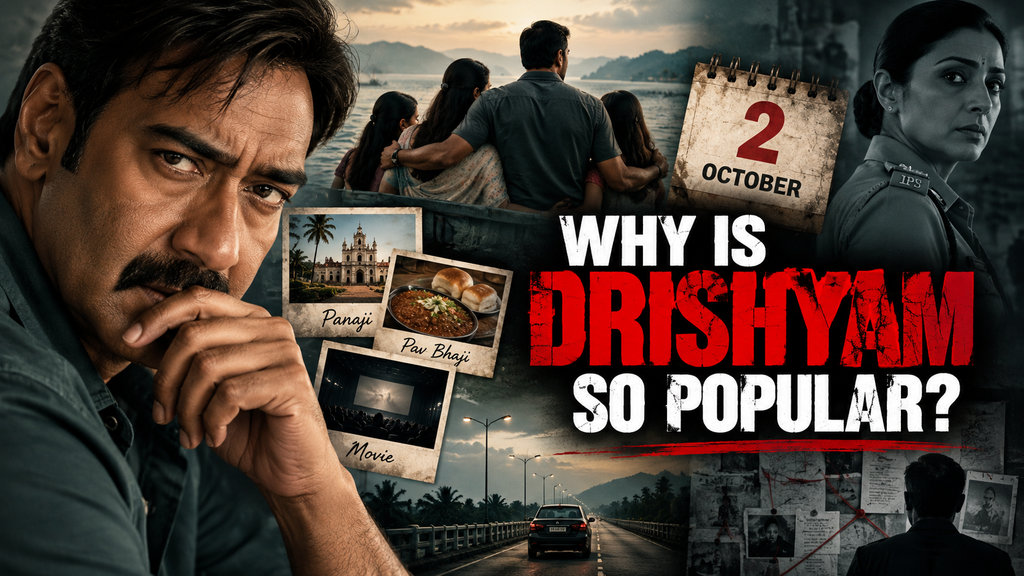
Few Indian thrillers have entered popular culture as deeply as Drishyam.
Mention October 2 to a Drishyam fan and there is a good chance they will immediately remember Panaji, a movie, a restaurant and Vijay Salgaonkar’s carefully constructed alibi. What began as Jeethu Joseph’s Malayalam thriller Drishyam in 2013 became a story powerful enough to be adapted into Hindi, Tamil, Telugu, Kannada, Sinhala and Mandarin Chinese versions. The Chinese adaptation, Sheep Without a Shepherd, itself became a major commercial success.
The Hindi version starring Ajay Devgn, Shriya Saran and Tabu arrived in 2015, followed by Drishyam 2 in 2022. The story now reaches its final Hindi chapter with Drishyam: The Conclusion, scheduled to release on October 2, 2026.
But why has a story without superheroes, spectacular action sequences or extravagant visual effects become such a phenomenon?
The answer lies in something much more powerful: psychology, family, moral conflict and extraordinarily clever storytelling.
1. Vijay Salgaonkar Is an Ordinary Man in an Extraordinary Situation
One of Drishyam’s greatest strengths is its protagonist.
Vijay Salgaonkar is not a police officer, secret agent, lawyer, gangster or detective. He does not possess political influence or extraordinary physical power.
He is essentially an ordinary middle-class family man.
That immediately changes the audience’s relationship with him.
When an action hero escapes from ten armed men, we expect it. When Vijay escapes from an increasingly sophisticated police investigation using observation, preparation and knowledge gained partly from watching films, we want to understand how he did it.
Vijay represents an attractive fantasy for an ordinary viewer: the idea that intelligence can sometimes defeat power.
His strength does not come from a gun.
It comes from his ability to think several moves ahead.
That makes him much easier to relate to than the typical larger-than-life movie hero.
2. Drishyam Makes the Audience Side With the Suspect
This may be the franchise’s cleverest psychological trick.
In a conventional crime thriller, a crime occurs and the audience usually wants the investigator to discover the truth.
Drishyam reverses that relationship.
The audience knows what happened.
We understand the circumstances that led to it.
Most importantly, we have already emotionally connected with Vijay and his family.
So when the police move closer to discovering the truth, instead of celebrating the investigation, viewers become nervous.
When the police find a clue, we worry.
When a family member is questioned, we hope they remember the story Vijay has taught them.
When investigators begin connecting the dots, we want Vijay to have already anticipated their next move.
The film has effectively turned the viewer into Vijay Salgaonkar’s silent accomplice.
That is a remarkably effective storytelling device.
We are no longer simply watching the investigation.
We are emotionally trapped inside it.
3. The Stakes Are About Family, Not Money
Drishyam would have been a very different movie if Vijay were simply trying to save himself.
Instead, his actions are motivated by his desire to protect his wife and daughters.
That instantly raises the emotional stakes.
Audiences may disagree with some of Vijay’s decisions. They may debate whether his actions are legally or morally justified.
But they understand his motivation.
That distinction is crucial.
Drishyam does not necessarily ask viewers to believe that everything Vijay does is right.
Instead, it asks a far more uncomfortable question:
What would you do if your own family were in the same situation?
Suddenly the story stops being a simple puzzle about crime and evidence.
It becomes personal.
The thriller engages the brain, while the family drama engages the emotions.
That combination is one of the main reasons the story has worked across different languages and cultures.
4. The Audience Sees the Plan Before Understanding It
Another major strength of Drishyam is the way it controls information.
Vijay performs seemingly ordinary actions.
He travels somewhere.
He buys something.
He visits a restaurant.
He interacts with people.
He keeps receipts.
He creates memories.
Initially, some of these actions appear almost meaningless.
Later, the audience discovers that they were pieces of a much larger strategy.
That creates one of the most satisfying feelings in mystery storytelling:
“It was right in front of me all along.”
The best twists are not necessarily those that come completely out of nowhere.
A truly satisfying twist often makes perfect sense after it has been revealed.
The viewer mentally returns to earlier scenes and suddenly understands why seemingly insignificant details mattered.
Drishyam repeatedly uses this technique.
It does not simply hide information.
It shows information before telling us why the information is important.
That makes viewers active participants rather than passive spectators.
5. Vijay Wins Through Intelligence, Not Physical Strength
Mainstream Indian cinema has traditionally celebrated heroes who defeat powerful enemies physically.
Drishyam offers something different.
Vijay cannot overpower the police department.
He cannot intimidate senior officers.
He does not possess an army of supporters.
His only realistic advantage is preparation.
So his battle becomes one of information.
What does the police know?
What will they ask?
What can witnesses remember?
What timeline will investigators construct?
What evidence can exist?
What story must every member of the family remember?
Watching these layers unfold feels almost like watching a chess match.
And intelligent protagonists are satisfying because viewers enjoy trying to think along with them.
Every time Vijay appears to be trapped, the audience asks:
Has he already thought of this?
That question alone keeps the suspense alive.
6. The Police Are Not Made Stupid Just to Make Vijay Look Smart
Many thrillers make a common mistake.
They want the hero to look brilliant, so they make everyone opposing the hero incompetent.
Drishyam largely avoids that shortcut.
The investigators are capable.
They question inconsistencies.
They apply pressure.
They test statements.
They look for physical evidence.
They understand that Vijay may be manipulating them.
This makes Vijay’s strategy much more impressive.
A chess player looks brilliant when defeating another strong player—not when the opponent does not understand the rules of chess.
That is one reason the cat-and-mouse element of Drishyam remains so entertaining.
Both sides are thinking.
And the viewer is constantly trying to determine who is one move ahead.
7. Drishyam 2 Did Something Most Sequels Fail to Do
The first Drishyam had such a satisfying conclusion that making a sequel could easily have felt unnecessary.
Instead of simply repeating the first film’s formula, Drishyam 2 asked a more interesting question:
What happens after you successfully hide a terrible secret?
A police case may become inactive.
Life does not.
The family continues carrying fear, trauma and guilt.
People in the community continue talking.
Investigators may continue being suspicious.
And Vijay must live every day knowing that one unexpected development could destroy everything he built.
This gives the sequel a reason to exist.
The second film is therefore not simply about another cover-up.
It is about the consequences of the first one.
The Hindi Drishyam 2, directed by Abhishek Pathak and released in 2022, continued Vijay Salgaonkar’s story while retaining the central narrative created by Jeethu Joseph.
That sense of continuity helped transform Drishyam from a successful standalone thriller into a genuine franchise.
8. October 2 Became Part of Indian Pop Culture
Very few movies can turn an ordinary date into a piece of franchise branding.
Drishyam managed to do exactly that.
October 2 is central to the Salgaonkar family’s fabricated timeline, and over the years the date has become a recurring meme and reference among fans.
The Hindi franchise has embraced that association so strongly that Drishyam: The Conclusion is releasing on October 2, 2026, with its promotional campaign referring to the date as “Drishyam Day.”
That level of recall is extremely valuable.
Audiences forgetting a plot detail is normal.
Remembering a fictional character’s alibi years later is something else entirely.
It shows that the movie has crossed the boundary between entertainment and popular culture.
9. The Story Works Across Languages and Cultures
Another remarkable aspect of Drishyam is how successfully its basic premise has travelled.
The original Malayalam film led to adaptations in multiple Indian languages as well as Sinhala and Mandarin. The Mandarin remake Sheep Without a Shepherd was released in China in 2019.
Why can the story travel so easily?
Because the central conflict is universal.
You do not need to understand a particular regional culture to understand a parent’s desire to protect a child.
You do not need to belong to a particular country to understand fear of a powerful institution.
And you do not need to speak the same language to understand the question at the centre of the story:
How far would you go to protect your family?
That emotional idea can work almost anywhere.
10. Drishyam Turns Viewers Into Participants
Perhaps this is the biggest reason Drishyam remains so addictive.
Most movies ask you to watch what the protagonist does.
Drishyam asks you to think with the protagonist.
When Vijay creates an alibi, we try to remember it.
When the police question someone, we mentally compare their answers with Vijay’s instructions.
When new evidence appears, we immediately start calculating whether Vijay anticipated it.
When investigators appear to have finally cornered him, we wonder whether this too is somehow part of his plan.
That transforms the viewing experience.
The audience is not merely waiting for something to happen.
The audience is constantly solving, predicting and reconsidering.
In other words, Drishyam behaves almost like a cinematic puzzle.
And people love puzzles that make them feel intelligent.
Is Vijay Salgaonkar Really a Hero?
This is another reason discussions about Drishyam rarely end when the credits roll.
What exactly is Vijay Salgaonkar?
A hero?
A criminal?
A brilliant strategist?
A manipulator?
A desperate father?
The answer depends largely on whose perspective you choose.
From his family’s point of view, he is their protector.
From the investigators’ perspective, he is obstructing the truth.
From another family’s perspective, his actions prevent them from discovering exactly what happened to someone they loved.
And from the audience’s perspective?
Things become uncomfortable.
We understand Vijay.
We may even want him to succeed.
But understanding someone’s actions is not necessarily the same as declaring those actions morally right.
That ambiguity gives Drishyam something many thrillers lack: a reason to debate the story afterwards.
Why Drishyam Still Matters
The success of Drishyam proves that Indian audiences do not always need enormous budgets or visual spectacle to become deeply invested in a film.
Sometimes the most powerful cinematic weapon is simply a strong idea.
Drishyam gives us:
- an ordinary protagonist,
- extraordinary circumstances,
- a family worth emotionally investing in,
- intelligent investigators,
- carefully planted information,
- moral ambiguity,
- and twists that emerge from the story rather than simply being added for shock value.
Most importantly, it repeatedly asks viewers to place themselves in Vijay Salgaonkar’s position.
What would you have done?
There is no easy answer.
And perhaps that is exactly why the story stays in our minds.
The Final Chapter: Drishyam – The Conclusion
The Hindi story is now heading towards its final chapter.
Drishyam: The Conclusion, directed by Abhishek Pathak, releases theatrically on October 2, 2026. Ajay Devgn returns as Vijay Salgaonkar alongside Tabu and Shriya Saran, while Jaideep Ahlawat is among the major additions to the cast.
The choice of October 2 brings the franchise back to the date that has become inseparable from Vijay Salgaonkar’s story.
Whatever the final outcome may be, Drishyam has already achieved something much larger than creating a successful thriller franchise.
It made audiences remember a fictional alibi.
It made viewers root against investigators who were trying to uncover the truth.
It transformed an ordinary family man into one of Indian cinema’s most fascinating strategic protagonists.
And most importantly, it proved that sometimes the greatest suspense does not come from asking:
“Who committed the crime?”
It comes from asking:
“How long can they keep the truth hidden?”
That is the real genius of Drishyam.